The Ultimate Eczema Food Guide
Congrats on gaining access to this spreadsheet! This is the first of its kind! No other resource exists that allows you to look up a food and see its relationship to eczema like this one does. The data in this guide has been cross-referenced to get the most accurate information and will always take the side of caution.
How this can help:
- First way is when you flare from a meal, you can look up the ingredients and hypothesize why that may have happened.
- Second way is if you already know your root cause. Use this to learn which foods will support you in healing.
- Third way is deducing your root cause based on what foods you react to.
Scroll below the chart to understand more about each section & view sources.
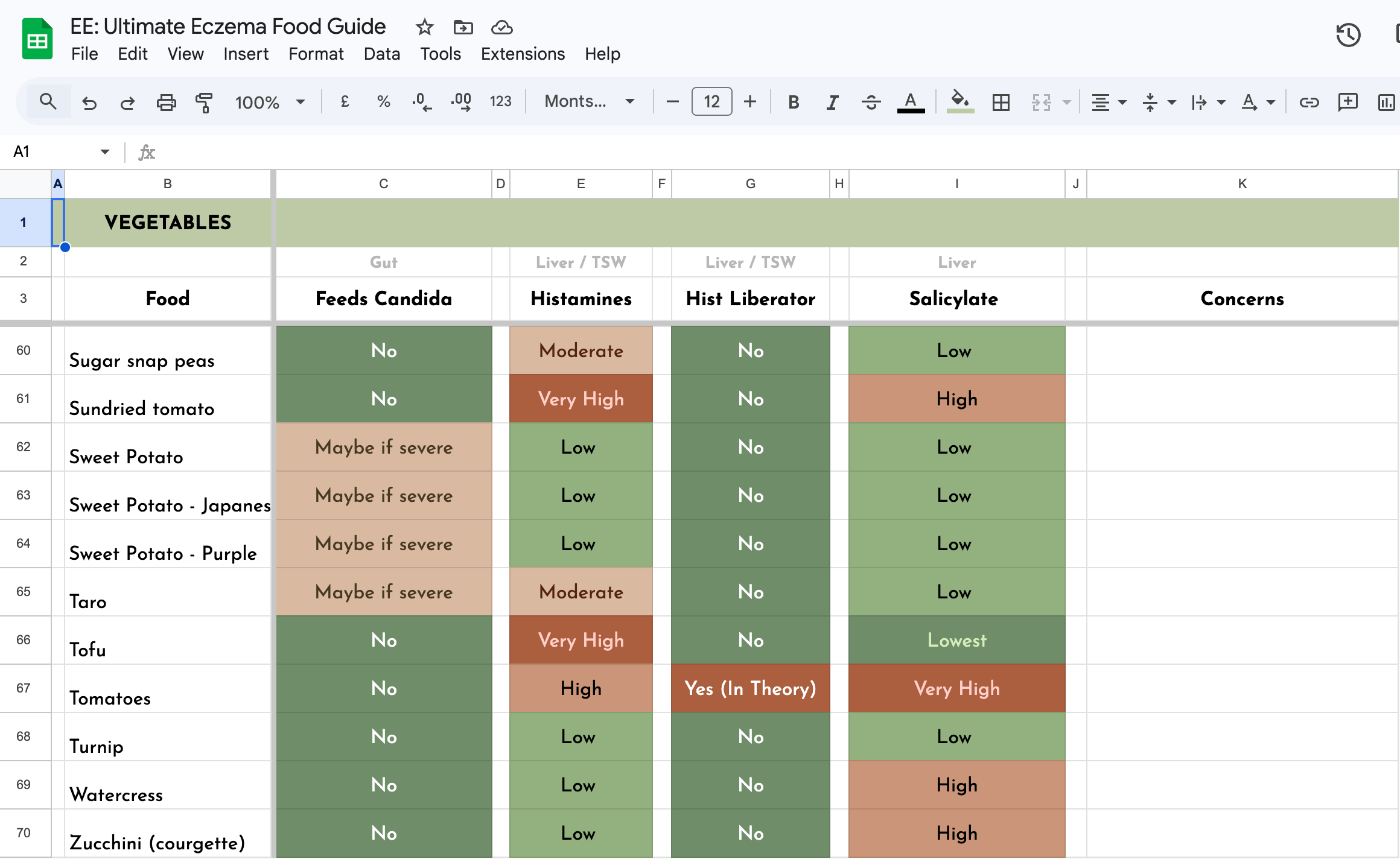
New/Simplified Version
This version of the guide is the one I am actively updating. I removed HS SIBO and nitric oxide to simplify it. I added histamine liberators.
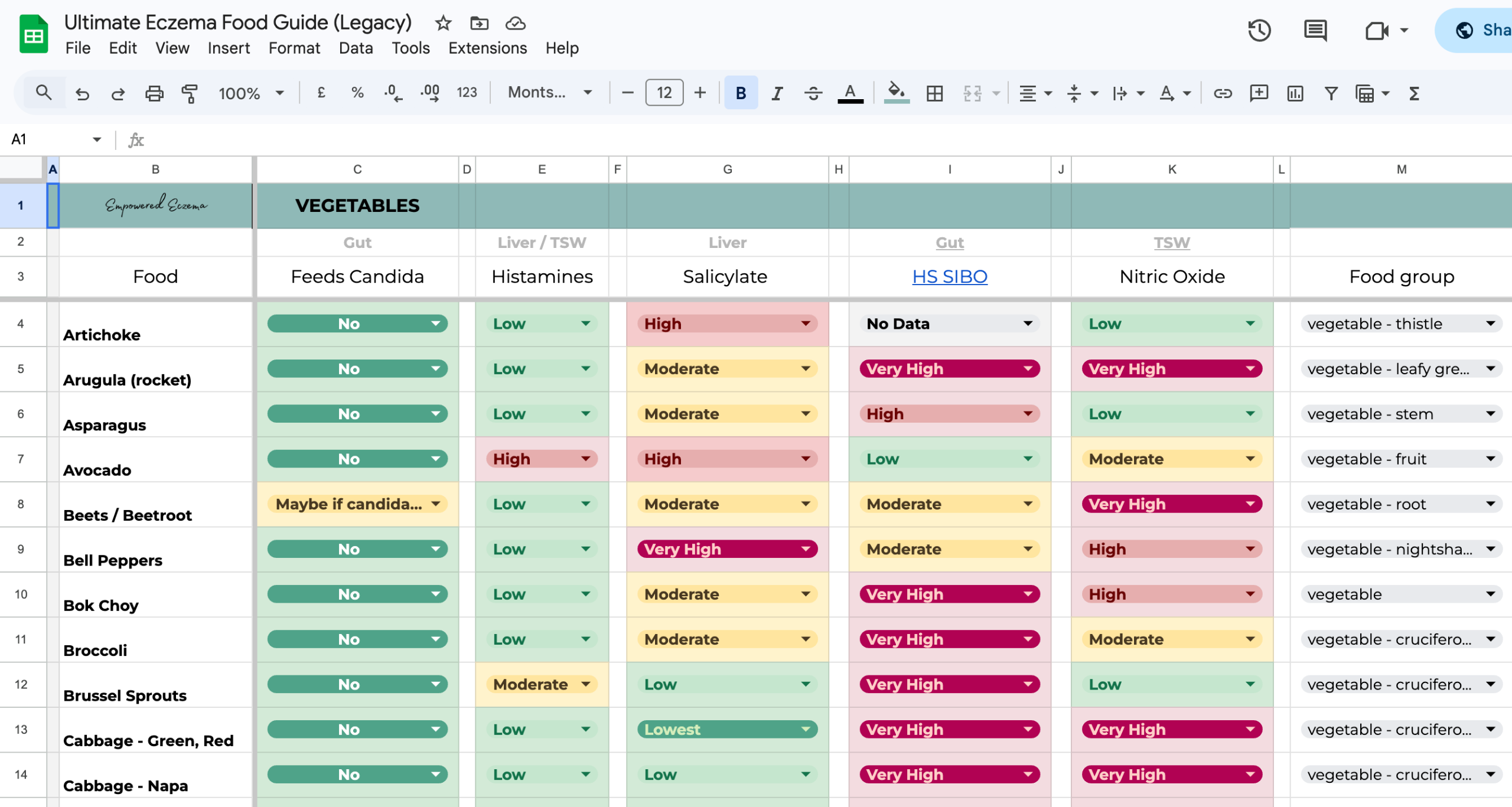
Legacy Version
Some of you may be more familiar with this version of the spreadsheet. Feel free to use it if you are more comfortable with this one.
Details & Sources
Feeds Candida
Candida refers to a yeast overgrowth in the gut. This column will tell you if a food feeds candida or not. Sugars and starches typically feed candida the most. Candida can cause flares on your skin folds and around the mouth. Other symptoms are craving sugar, experiencing brain fog, & flaring after eating sugar.
You can avoid foods that feed candida while strategically using supplements to eliminate the excess candida in the gut.
Histamines
Food can naturally contain histamine or develop histamines from fermenting, aging, or spoiling. You might react immediately to eating high-histamine foods, but this one is tricky. You could also have a build-up of histamines that causes you to have react nights & mornings. An intolerance usually points to a liver and/or gut issue. Note: most people with TSW struggle with histamine-containing foods (espcially, histamine liberators)
If you are reacting to foods high in histamine that are NOT histamine liberators, it's a sign that you aren't producing enough DAO enzymes. You can supplement with this or learn how to increase it naturally inside Histamine Harmony.
Salicylates
Salicylates are organic chemicals naturally found in foods, which, if your liver is overworked, these foods cause itchiness. A salicylate intolerance typically makes you feel itchy immediately after eating high salicylate foods.
If you react to salicylates, it means that your liver is likely overworked, and detoxing it will help tremendously.
Histamine Liberators & Mast Cells
Note: While it is currently being debated whether foods can trigger mast cells to release histamine, I wanted to share the most accurate information I could find. I (Michelle) can say that even now (2025), I struggle to eat many foods on this list.
Certain foods seem to stimulate mast cells to release histamine, even when those foods don’t contain high amounts of histamine themselves. Research on this is still developing; most evidence comes from clinical observation rather than direct biochemical proof.
Citrus fruits – Oranges, lemons, and other citrus contain bioactive amines and flavonoids such as limonene and naringenin that may destabilize mast cells or interfere with histamine-degrading enzymes. Some individuals experience flares after citrus exposure even though histamine levels in the fruit are low. Unconfirmed/Theoretical.
Tomatoes – Naturally rich in alkaloids and solanine-like compounds that may irritate intestinal or immune cells. Tomatoes also contain high levels of putrescine, a polyamine that can influence histamine metabolism and possibly trigger mast-cell activation. Unconfirmed/Theoretical.
Strawberries – Contain polyphenols that can alter mast-cell calcium signaling, leading to histamine release in lab studies. Clinically, they are among the most frequently reported liberators in people with histamine intolerance. Unconfirmed/Theoretical.
Pineapple – The enzyme bromelain can modify immune responses and, in some individuals, may cause histamine-like symptoms. Some clinicians theorize that bromelain affects mast-cell permeability, though this has not been confirmed in vivo. Unconfirmed/Theoretical.
Papaya – Contains papain, an enzyme capable of stimulating immune cells in sensitive people. Reactions may involve mast-cell activation rather than histamine ingestion itself. Unconfirmed/Theoretical.
Bananas – Over-ripe bananas are high in polyamines such as putrescine, which may interfere with histamine metabolism or provoke mast-cell degranulation in susceptible individuals. Unconfirmed/Theoretical.
Shellfish – Shrimp and crab are known triggers of both IgE-mediated allergy and non-IgE histamine release. Some shellfish contain natural biogenic amines that may provoke direct mast-cell activation. Partially confirmed (limited human data).
Chocolate and cocoa – Contain methylxanthines like theobromine and caffeine, which can increase cyclic AMP and transiently activate mast cells, resulting in histamine release in some sensitive people. Unconfirmed/Theoretical.
Caffeine-containing foods — Caffeine raises cyclic AMP (cAMP) levels inside cells, which in theory should help stabilize mast cells. However, when the body is already under stress, depleted, or inflamed, caffeine can have the opposite effect: it heightens adrenal output and intracellular calcium, two signals that can encourage mast cells to degranulate and release histamine. This is why some people tolerate coffee or tea without issue, while others experience flares, flushing, or anxiety. Caffeine foods are therefore not true “histamine liberators,” but rather mast-cell modulators that can exacerbate histamine responses in sensitive individuals. Unconfirmed/Theoretical
Spinach – Contains both histamine and polyamines; certain forms of folate and oxalate may also irritate intestinal mucosa and indirectly stimulate mast cells. Unconfirmed/Theoretical.
Egg white – The protein ovomucoid can activate innate immune responses and has been shown in some studies to cause histamine release independent of allergy. Unconfirmed/Theoretical.
Nuts (especially peanuts, walnuts, cashews) – Contain lectins and storage proteins that can activate mast cells in vitro. These effects appear to be individual and dose-dependent. Unconfirmed/Theoretical.
Pork – Rich in polyamines, especially when processed or stored; may also alter DAO enzyme activity, contributing indirectly to higher histamine load. Unconfirmed/Theoretical.
Alcohol – Ethanol and its metabolites (especially acetaldehyde) can cause mast-cell degranulation directly and inhibit diamine oxidase (DAO), leading to elevated circulating histamine. Well-established mechanism.
Certain spices (cinnamon, cloves, chili, curry blends) – Contain capsaicin, eugenol, and cinnamaldehyde, which can activate TRPV1 receptors on mast cells, stimulating histamine release. Partially confirmed (cell studies).
(Sources: Maintz & Novak 2007; Comas-Basté et al. 2020; Joneja 2009; SIGHI Database, 2023 — evidence generally unconfirmed/theoretical.)
Key Takeaway
While histamine-liberating foods are still considered a theoretical concept in scientific literature, many people with histamine intolerance, eczema, or mast-cell sensitivity report consistent reactions to these foods. Until stronger data are available, it can be helpful to treat these as potential mast-cell triggers and reintroduce them cautiously once gut and immune balance are restored.